

What Is a Gravity Filling Machine?
A gravity filling machine is a type of liquid filling equipment that relies on gravity to dispense liquids into containers (bottles, jars, or cans). It is widely used in industries like beverages, pharmaceuticals, cosmetics, and chemicals due to its simplicity, cost-effectiveness, and versatility.
How Gravity Fillers Work
Basic Principle
Gravity fillers operate on the principle that liquid flows downward due to gravity. The machine controls the flow rate and volume by opening/closing valves for a precise duration.
Step-by-Step Process
- Container Positioning:
- Bottles/jars are placed under the filling nozzles via a conveyor or starwheel system.
- Sensors detect container presence to trigger filling.
- Valve Opening:
- A solenoid or pneumatic valve opens, allowing liquid to flow from the holding tank into the container.
- Fill time is pre-set based on liquid viscosity and desired volume.
- Filling:
- Liquid flows until the container reaches the target level.
- Nozzles may include drip trays or anti-foam designs for clean filling.
- Valve Closing:
- The valve closes automatically after the set fill time.
- Excess liquid (if any) is recycled or drained.
- Container Release:
- Filled containers move to the next station (capping, labeling, etc.).
- Empty containers are detected and rejected (if integrated with a PLC).
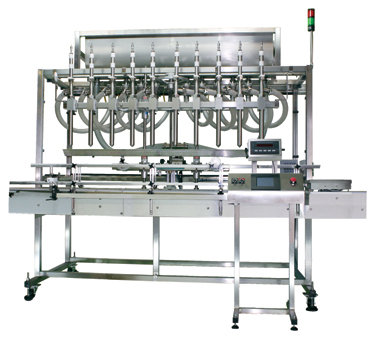
The product bulk supply is pumped into a holding tank above a set of pneumatically operated valves. Each valve is independently timed by the filler’s master computer so that precise amounts of liquid will flow by gravity into the container. Gravity fillers built with bottom up fill capability can handle a wide range of flowable liquids including foamy products.
Application
This type of filler is best suited for liquids with very thin viscosities that do not change with ambient temperature or with batch variation. This machine is also suited for applications where recirculation of the liquid in the fluid path is not desirable. Although this type of filler is used predominantly on products that do not foam, foam may be limited and controlled by subsurface/bottom-up-fill capability.
Examples
Water, solvents, alcohol, specialty chemicals, paint, inks, corrosive chemicals i.e. acids and bleach.
Advantages
This is the most economical type of filling machine for a limited range of applications. It is especially well suited for corrosive chemicals.
FAQs
What types of liquids are compatible with gravity fillers, and how do I choose the right one for my product?
Gravity fillers are ideal for free-flowing, low-viscosity liquids (e.g., water, juices, thin oils, or solvents) due to their reliance on gravity for flow control. However, they can also handle moderately viscous liquids (e.g., syrups, sauces, or light creams) if the equipment is adjusted for slower flow rates and larger nozzle diameters.
Key considerations for liquid compatibility:
Viscosity: Liquids thicker than 500 cP may require a – pump-assisted gravity filler or a volumetric filler.
Foaming: For foamy liquids (e.g., beer, carbonated drinks), use anti-foam nozzles or overflow fillers to prevent spillage.
Corrosiveness: Stainless steel (316L) gravity fillers are recommended for acidic/alkaline liquids (e.g., cleaning agents, pharmaceuticals).
Particulates: Liquids with particles (e.g., fruit pulps) need wide-bore nozzles to avoid clogging.
Pro Tip: Test your liquid’s flow rate with a sample filler setup before full-scale production. Use a viscosity chart to match your product to the right nozzle size.
How do I adjust a gravity filler to prevent overfilling or underfilling in my production line?
Step-by-Step Adjustment Guide:
Calibrate the Flow Rate:
Adjust the fill valve opening time (e.g., 2–5 seconds for water, 5–8 seconds for syrups).
Use a flow meter to measure liquid volume per second.
Set the Nozzle Height:
Position nozzles 1–2 cm above the bottle neck to avoid splashing.
For viscous liquids, use longer nozzles to reduce turbulence.
Test with Sample Bottles:
Fill 10–20 bottles and weigh them to check consistency.
Adjust the fill time or nozzle diameter if weights vary by >1%.
Automate with Sensors:
Install level sensors or load cells to stop filling at the exact volume.
Use PLC controls for real-time adjustments.
Pro Tip: For high-precision filling, pair your gravity filler with a weight-based feedback system (e.g., checkweigher).
What are the pros and cons of gravity fillers compared to volumetric fillers for viscous liquids?
Gravity Filler: Best for low-to-medium viscosity liquids (e.g., sauces, thin creams) where speed and simplicity are priorities.
Volumetric Filler: Best for high-viscosity or chunky liquids (e.g., peanut butter, lotions) where precision outweighs speed.
Can gravity fillers be used for carbonated beverages like beer or sparkling water without losing fizz?
No, standard gravity fillers are not ideal for carbonated drinks because they release CO₂ during filling, leading to flat products or excessive foaming.
Solutions for Carbonated Beverages:
Overflow Fillers:
Designed to minimize foam by filling from the bottom and allowing excess liquid to overflow.
Example: Used by 90% of craft breweries for bottling beer.
Counter-Pressure Fillers:
Pressurize the bottle with CO₂ before filling to preserve carbonation.
Example: Used for sparkling wines and sodas.
Modified Gravity Fillers (Rare):
Some gravity fillers include CO₂ purging before filling, but this is less common.
Data Point: A study by Brewers Association found that overflow fillers reduce CO₂ loss by 60% compared to gravity fillers for beer.
How can I automate a gravity filling line for high-speed production?
Steps to Automate:
Integrate with Conveyor Systems:
Use servo-driven conveyors to sync bottle movement with filling.
Example: Dorner or FlexLink conveyors for speeds up to 300 bottles/min.
Add PLC Controls:
Program a PLC (e.g., Siemens S7-1200) to: Control fill times based on bottle size.
Stop filling if a bottle is missing (via photoeye sensors).
Automate Bottle Handling:
Use starwheels or screw caps to position bottles precisely under nozzles.
Add air blowers to clear nozzle drips between fills.
Implement Weight Feedback:
Connect a checkweigher to adjust fill times dynamically for consistency.
What safety and hygiene standards must gravity fillers meet for pharmaceutical or medical liquid filling?
Regulatory Standards:
GMP (Good Manufacturing Practice):
Material: 316L stainless steel (electropolished for smooth surfaces).
Design: No dead legs (areas where liquid can stagnate); self-draining nozzles.
FDA 21 CFR Part 11 (USA) / EU GMP Annex 1:
Validation: IQ/OQ/PQ documentation for filler calibration and cleaning.
Cleaning: CIP (Clean-In-Place) or SIP (Sterilize-In-Place) compatible.
ISO 14644 (Cleanrooms):
For aseptic filling, use fillers in ISO Class 5–7 cleanrooms.
Key Features for Compliance:
Seals: FDA-approved silicone or EPDM (no latex).
Filters: 0.2-micron HEPA filters for air vents.
Documentation: Logs for fill weights, temperatures, and cleaning cycles
How do I clean and maintain a gravity filler to avoid cross-contamination between different liquids?
Cleaning Protocol:
Daily Cleaning:
Flush nozzles and tanks with hot water (60–80°C).
Use food-grade detergent (e.g., Ecolab P3) for residue removal.
Product Changeover:
Disassemble nozzles and soak in sanitizing solution (e.g., quaternary ammonium).
Run CIP (Clean-In-Place) with caustic soda (1–2%) for 15–30 mins.
Weekly Maintenance:
Inspect seals and gaskets for wear; replace if cracked.
Lubricate moving parts (e.g., valves) with food-grade grease.
Validation:
Test for residues with ATP swabs (e.g., 3M Clean-Trace).
Document cleaning in logbooks for audits.
Cross-Contamination Prevention:
Dedicated Nozzles: Use color-coded nozzles for different liquids.
Air Purge: Blow nozzles with filtered air between product changes.
Allergen Control: For food/pharma, use segregated filling lines.
Gravity vs Overflow — when to use each
| Feature | Gravity Filler | Overflow Filler |
|---|---|---|
| Best for | Still liquids (water, wine, oil) | Carbonated/fizzy liquids (beer, soda) |
| Speed | Moderate (50–200 bottles/min) | High (200–600 bottles/min) |
| Precision | High (±1–2% variance) | Very high (±0.5% variance) |
| Bottle Compatibility | Glass, PET, HDPE | Glass (best for foamy liquids) |
| Maintenance | Low (fewer moving parts) | Moderate (seals/nozzles need cleaning) |
| Cost | Lower initial cost | Higher (complex design) |